
PUBLICATION: Nuevo pensamiento sobre seguridad en América Latina (CLACSO)

Congratulations to our network members Alexandra Abello ColakJuan Carlos Ruiz and Susan Hoppert-Flämig who have been involved in the publication of this great new book (download here)!

“Nuevo pensamiento sobre seguridad en América Latina. Hacia la seguridad como un valor democrático”
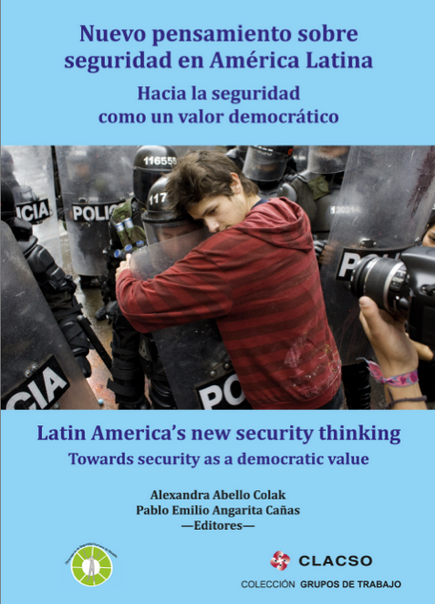
clacsoAlexandra Abello Colak y Pablo Emilio Angarita Cañas [Editores]

Markus Gottsbacher, Alvaro Guzmán Barney, Ruiz Juan Carlos, Susan Hoppert-Flämig, Alexandra Abello Colak, Pablo Emilio Angarita Cañas, Andrea Bolcatto, Joaquín Salazar, Darío Nicolás Rolón, Lucía Dammert [Autores de Capítulo]

Si hay un hilo conductor que une todos los capítulos intelectualmente estimulantes de este libro es que la seguridad en América Latina ya no puede ser equiparada al orden y a la represión, o, en otras palabras, al campo conceptual dominado por la “derecha” y el pensamiento conservador. El campo de la seguridad se ha abierto a un público más amplio. Ahora hay un nuevo cuerpo de pensamiento sobre seguridad en América Latina, del cual esta recopilación de ensayos forma parte importante y el cual ha empezado a construir un concepto de seguridad como valor democrático, integral en otras palabras, a la construcción del proceso democrático y que no puede violar ese proceso en su ejecución.

CALL FOR PAPERS: Delito y Sociedad, Revista de Ciencias Sociales (Argentina)

“Delito y Sociedad” is one of the most important journals in the field of criminology in Argentina, jointly published by the University of Buenos Aires and the Universidad Nacional del Litoral.

More information and guidelines on how to publish your research in this  journal can be found in this document.

POST-DOC: Call for Post-Doctoral Projects at the Institute for Democracy (Quito, Ecuador)

Call for Post-Doctoral Projects (one year – Quito, Ecuador)
The Institute for Democracy (http://www.institutocne.gob.ec) is a research centre specialised in election studies and attached to the National Electoral Council (CNE) of Ecuador. In the framework of analyses of comparative electoral systems, national and sub-national elections, electronic voting, and direct democracy, we are seeking two (2) Post-Doctoral researchers. The appointment will begin on February 1st, 2014 or upon agreement.

Research Priorities for 2014

The Institute for Democracy is a public institution attached to the National Electoral Council of Ecuador (CNE). The institute is involved in the triple function of scientific research, training and technical assistance to electoral public servants and political parties, and the service to the community in the area of empowerment, political and civil rights, and citizenship.

Our research priorities for 2014 are:

  • Quantitative analysis of the 2014 sub-national elections with special emphasis on variables such as gender parity, panachage, district magnitude and proportionality.
  • Comparative analysis of the 2014 electronic voting pilot projects in Ecuador with special emphasis on electoral turnout, security, transparency and efficiency.
  • Quantitative and qualitative analysis of local institutions with special emphasis on local governance, local governability and direct democracy.

Position / Profile
Candidates should be interested in comparative electoral and democracy studies and have a very good knowledge of quantitative methods. They must have completed a PhD in political science, statistics or related fields including communication science and sociology. Candidates need to be fluent in English. The knowledge of Spanish is an asset. The selected Post-Doctoral researchers will participate to the different scientific activities of the Institute for Democracy (publications, conferences, etc.).

Terms of employment
The work location is the Institute for Democracy in Quito, Ecuador. The selected candidates will be part of the Prometo Program and the salary is determined according to the Senescyt pay scale (4.320 USD/month) plus benefits (health care, travels, housing, etc.). The position is limited to one year. Feel free to contact Felipe Cisneros (felipecisneros@cne.gob.ec) for further information. The deadline for applications is November 15, 2013 or until the position is filled.

Applications
Applications should include a letter of motivation, a curriculum vitae (along with a list of publications) and the names and coordinates of three reference persons. Applications should also include a detailed research project on a topic related to the priorities of the Institute for Democracy for 2014 and contain:
–       a short bio of the candidate (100 words)
–       the objectives of  the research project (200 words)
–       the research question(s) and its limitation in time and space (500 words)
–       the contribution to the discipline and the literature (200 words)
–       the methodology (200 words)
–       the expected outcomes (publications, teaching materials, resources for public service, etc.) (200 words)

Please send your electronic application (in English) to Felipe Cisneros (felipecisneros@cne.gob.ec)

BOOK: Anthropology and Security Studies, edited by Fina Antón Hurtado and Giovanni Ercolani

anthropology-and-security-studies


The full book is available here.

Foreword: An Anthropological Approach to Security, Luis Álvarez Munárriz; Introduction: Anthropology and Security Studies, Fina Antón Hurtado and Giovanni Ercolani;

(1) Considerations on Anthropology and Critical Security Studies in a Globalized Context: The NATO Civil-Military Co-operation (CIMIC) Doctrine as an Anthropological Space, Giovanni Ercolani;

(2) Visual Ethnographies, Conflict and Security, Chris Farrands;

(3) The Psychology of Peacekeeping: One Domain Where Political Realism and Critical Security Theory Will Meet, Harvey Langholtz;

(4) ’The Revolution Continues Worldwide!’: Emancipatory Politics In an Age of Global Insecurity, Danielle Moretti-Langholtz;

(5) Anthropological Methods in Counter-Trafficking Activities: Analysis of Criminal Networks and Victim-Oriented Approach, Desirée Pangerc;

(6) Anthropology and Conflicts, Marco Ramazzotti; Conclusions: A New Grammar for International Relations in a New World Order, Maurizio Boni.

SEMINAR: What Happens When Governments Negotiate with Criminal Networks? Case Studies from the Americas (30 October 2013, Woodrow Wilson International Center for Scholars, Washington, DC)

Date: October 30, 2013
Time: 9:00am to 12:15pm
Venue: Fifth Floor Conference Room, Woodrow Wilson International Center for Scholars, 1300 Pennsylvania Ave NW, Washington, DC 20004

Featuring

  • Marcelo Fabián Sain, Universidad Nacional de Quilmes: Argentina
  • Graham Denyer Willis, University of Toronto: Brazil
  • Max Yuri Gil Ramirez, Corporación Región: Colombia
  • Marcela Smutt, UNDP: El Salvador
  • Edward Maguire, American University: The United States, Trinidad and Tobago

Invitation to follow.

NEWS: 2014 Visiting Fellowships, University of Nottingham, UK

2014 Visiting Fellowships

The University of Nottingham’s International Office is pleased to announce the launch of the 2014 Visiting Fellowship Scheme, which will allow 30 early career researchers from outside the European Union (EU) the opportunity to complete a three month period of research in Nottingham.

What are the aims of the 2014 Visiting Fellowship Scheme?

  • Promote research collaboration between leading groups in Nottingham and partner countries through projects undertaken initially at Nottingham
  • Support capacity development with universities in the partner countries
  • Enable Visiting Fellows to obtain insight into the organisation and conduct of research, training and administration at Nottingham
  • Help support developing partnerships and identify possible new partnerships in the partner countries

For more information, please click here.

WORKSHOP: Beyond international security: social security and social welfare in the Middle East and North Africa – what are the research and policy choices? (3 December 2013, University of Bath, UK)

Date: 3 December 2013

Time: 09.00 – 17.30

Venue: Chancellors’ Building, University of Bath, UK

Programme: For the full workshop programme, please see the Call for Participants(pdf)

Who should attend: This workshop is open to interested participants from academia, the governmental and non-governmental sectors. Please register your interest in attending the workshop by emailing the network coordinator, Dr Rana Jawad at r.jawad@bath.ac.uk.

Presenting a paper: Colleagues wishing to present a paper should email a  250 word abstract to Rana Jawad at r.jawad@bath.ac.uk by  25 October 2013.

Financial Matters and Bursaries for PhD Students: The workshop will be free of charge with a limited number of places available. A small number of travel bursaries for PhD students will also be available on a first come first served basis as follows: up to a maximum of £100 for UK-based PhD students and up to £200 for PhD students coming from overseas.

NB: Please note that priority of attendance will be given to delegates who are directly involved through their professional activities or academic research in an area of social policy or international security that is relevant to the workshop.

About this workshop: To mark the recent establishment of the Middle East and North Africa (MENA) Social Policy Network which is dedicated to the promotion of research on issues of social protection and social welfare in the MENA region, we are pleased to announce that our first workshop is to be held on Tuesday 3 December 2013 at the University of Bath’s Institute for Policy Research (IPR), Bath, UK.

Social security to protect the local populations of the MENA region from poverty and deprivation has – at long last – become an issue of major international concern – on a par perhaps, with the more traditional concern of international security. Both national governments in MENA and global development agencies (led by the ILO, World Bank, DFID and UN agencies) are now seeking to articulate new social visions for this region’s diverse populations based on a regime of (a) social assistance and cash transfer programmes and (b) the promise of extended social security coverage. But what are the prospects for social protection as a tool for policy analysis in the MENA region and are there no already existing forms of social solidarity and social mobilization which contribute to the formation of viable future social policies?

The aim of this workshop is to highlight the pivotal importance of social justice and social welfare issues affecting local populations in the MENA region and to present the case for social policy as a vital form of public intervention aimed at solving the enormous social problems that this region faces. Moreover, the workshop will explore the particular trajectory of social policy in the MENA region and the tremendous scope for effective social activism which already exists there (prior to the Arab spring). Empirical research from around the MENA region, though limited in scope has shown already that local populations have long mobilised around issues of social justice on both secular and religious grounds yet these forms of action have received little attention from the public media and mainstream public policy debates.  Indeed, MENA countries have in operation systems of both state and non-state welfare provision which as yet, have received hardly any scrutiny in terms of their wider social impact.

This workshop will offer the first opportunity to take stock in a research-informed forum of the specificity of social welfare initiatives in the MENA region and crucially, what choices now lie ahead for researchers and policymakers working in this field.  The two main outputs from the workshop will be a report that sets out some of the key discussions and a suitable plan for future action by the network; as well as the preparation of a themed section on some key papers from the workshop to be published at a later date in an international journal.

NEWS: Scholarships for foreigners in Argentina and for Argentinians to go abroad

The “Programa de Becas Internacionales de Posgrado” by the Argentinian Ministry of Education has put together some useful information about postgraduate scholarships.

For foreigners that want to study in Argentina, click here.

For Argentinians that want to study abroad, click here.

CONFERENCE: Segundo Encuentro Regional de la Red Latinoamericana de Seguridad y Delincuencia Organizada –RELASEDOR (10 Oct 2013, Panama)

Organizadores: RELASEDOR; FLACSO; IDRC/CRDI

Lugar: Victoria Hotel & Suites. El Cangrejo, CalleD, Bella Vista, Panamá, Panamá.

Informes: relasedor@gmail.com


08h00-08h15 Inscripción de los participantes

08h15-09h00 Inauguración

  • Dra. Carmen Guadalupe Córdoba, Directora FLACSO Programa Panamá
  • Dr. Fredy Rivera, Profesor- investigador, FLACSO Ecuador
  • Lcda. Araceli de Casanova –Directora Nacional del  Sistema Nacional Integrado de Estadísticas
  • Criminales de Panamá

09h00-10h20 Primera Mesa: Avances y fundamentos de la Investigación en la RELASEDOR

Presentación del Proyecto RELASEDOR

  • Fredy Rivera – FLACSO Ecuador
  • Objetivos y avances de la RELASEDOR
  • Daniel Pontón – FLACSO Ecuador

Presentación de las redes de comunicación de la RELASEDOR

  • Gilda Guerrero – FLACSO Ecuador

10h20-10h40 Receso

10h40-12h20 Segunda Mesa: Resultados e Indicadores de Seguridad en el área norte y centroamericana

Resultados e indicadores de seguridad en Costa Rica

  • Rodolfo Calderón – Universidad de Costa Rica

Resultados e indicadores de seguridad en Panamá

  • José Lasso Núñez – FLACSO Panamá

Resultados e indicadores de seguridad en México

  • Miguel Garza- Convivencia Joven, AC

Resultados e indicadores de seguridad en Guatemala

  • Ingrid Rivera- Incidencia Democrática

12h20-13h40 Receso

13h40-15h00 Tercera Mesa: Resultados e Indicadores de Seguridad en zona andina

Resultados e indicadores de seguridad en Ecuador

  • Daniel Pontón – FLACSO Ecuador

Resultados e indicadores de seguridad en Colombia

  • Gustavo Duncan – Universidad de los Andes

Resultados e indicadores de seguridad en Perú

  • Enrique Castro – Taller de Asuntos Públicos

15h00-15h20 Receso

15h20-16h20 Cuarta Mesa: Resultados e Indicadores de Seguridad en zona sudamericana

Resultados e indicadores de seguridad en Brasil

  • Renato Sérgio de Lima – Foro Brasileño de Seguridad Pública

Resultados e indicadores de seguridad en Argentina

  • Alejandra Otamendi – Universidad de Buenos Aires

16h20-17h40 Quinta Mesa: Esquema metodológico estratégico

Fundamentos Teóricos y metodológicos para la construcción de indicadores de delincuencia organizada

  • Daniel Sansó-Rubert, Universidad Santiago de Compostela

Repaso de las estratégias metodológicas de la delincuencia organizada

  • Daniel Pontón – FLACSO Ecuador

SEMINAR: Cifras + Análisis = Construyendo Conocimiento para la Prevención del Delito (2 Oct 2013, Santiago de Chile, CEAD)

Message from the Centro Estratégico De Análisis Del Delito (CEAD), Ministerio del Interior y Seguridad Pública, Chile:

“Junto con saludarles cordialmente, tengo el agrado de invitarlos al seminario “Cifras + Análisis = Construyendo Conocimiento para la Prevención del Delito”. El seminario se realizará el miércoles 02 de octubre a partir de las 09:00 horas, en el salón Patagonia del Hotel Crowne Plaza, ubicado en Avenida Libertador Bernardo O’Higgins 136, comuna de Santiago.

Adjuntamos el programa de la actividad. Esperamos poder contar con su presencia en la jornada y a través de ustedes hacemos extensiva la invitación a sus equipos de trabajo.

Agradecemos confirmar su asistencia a la siguiente dirección de correo electrónico mquezadav@interior.gov.cl o al 25502884 y que nos ayuden a difundir la actividad.”

Programme: CEAD seminar